
Research Initiatives Bangladesh (RIB) organised a national dialogue titled “Interconnection Between Climate Justice and Gender Justice in Bangladesh: The Role of Media” on 3 November 2026 at Bishwo Shahitto Kendro, Dhaka. The event was organised under RIB’s project, Advancing Transitional Justice in Bangladesh 2026, with support from Rosa Luxemburg Stiftung (RLS), South Asia.
The dialogue brought together journalists, editors, researchers, academics and civil society representatives to explore the relationship between climate change, gender inequality and social justice in Bangladesh. Participants discussed how responsible and inclusive media coverage can contribute to greater public awareness, strengthen accountability and bring the experiences of climate-affected communities into national discussions.
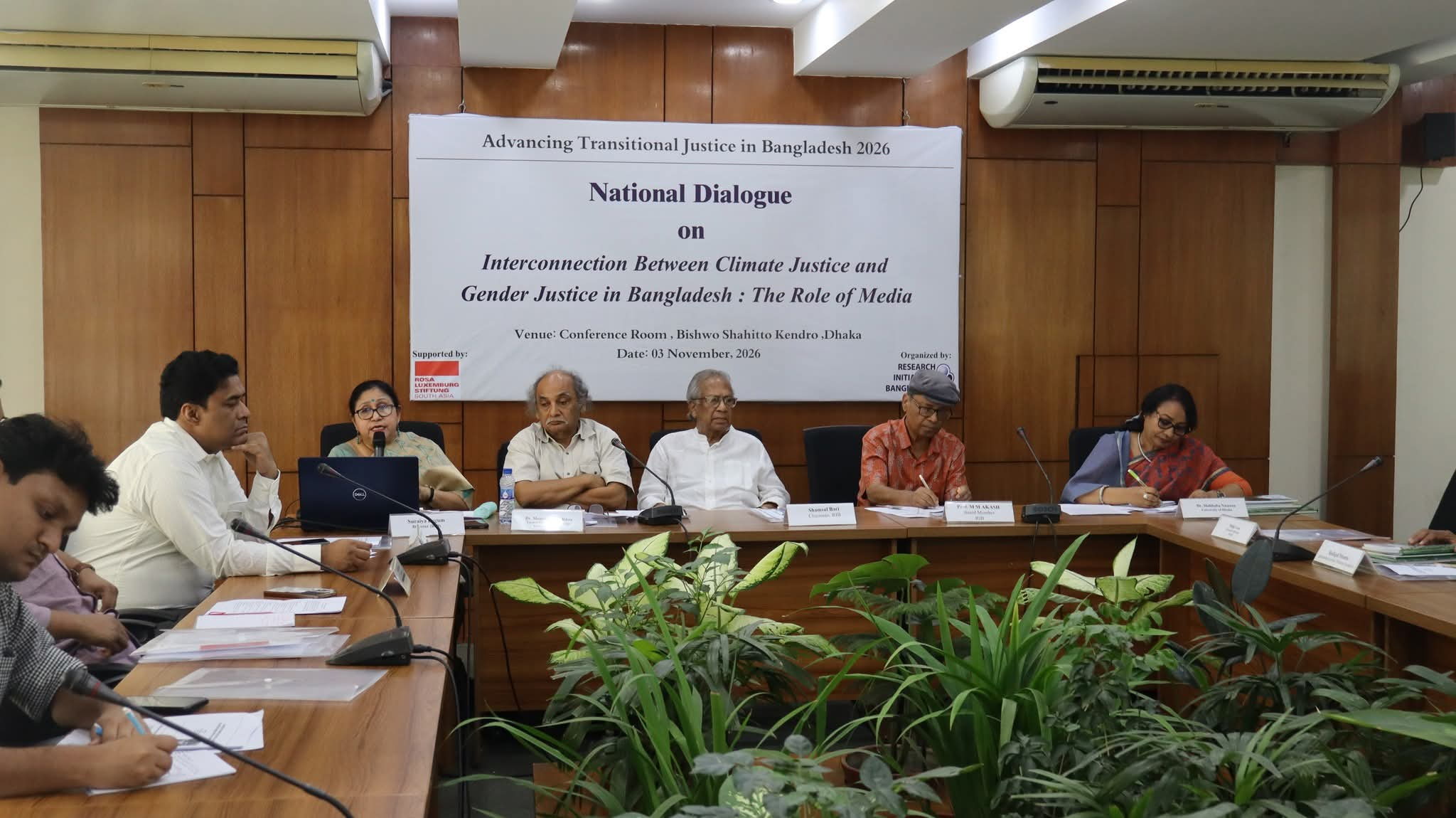
Fig: Interconnection Between Climate Justice and Gender Justice in Bangladesh: The Role of Media
AT A GLANCE
Theme
Climate Justice, Agriculture and Agroecology
Status
Ongoing
Where
Bangladesh
Period
...
Funded by
...
Partners
...
A major focus of the dialogue was the responsibility of media organisations in shaping public understanding of climate change and its social consequences.
Participants observed that climate reporting often concentrates on natural disasters, immediate damage, rescue operations and relief activities. While these subjects are important, such coverage may overlook the deeper structural issues behind climate vulnerability.
Strengthening gender-sensitive and inclusive journalism: Media coverage should reflect the different experiences of women, men and marginalised groups affected by climate change. Gender perspectives should be integrated into climate reporting rather than treated as a separate or occasional topic.
Bringing community experiences into national discussions: Journalists should give greater visibility to the voices, knowledge and lived experiences of climate-affected communities, particularly those whose perspectives are often underrepresented in mainstream media.
Promoting research-based reporting: Reliable data, academic research, field-level evidence and expert analysis should play a stronger role in climate journalism and policy discussions.
Encouraging collaboration and accountability: Stronger relationships among journalists, researchers, civil society organisations and affected communities can help produce more comprehensive reporting and encourage greater institutional accountability.