
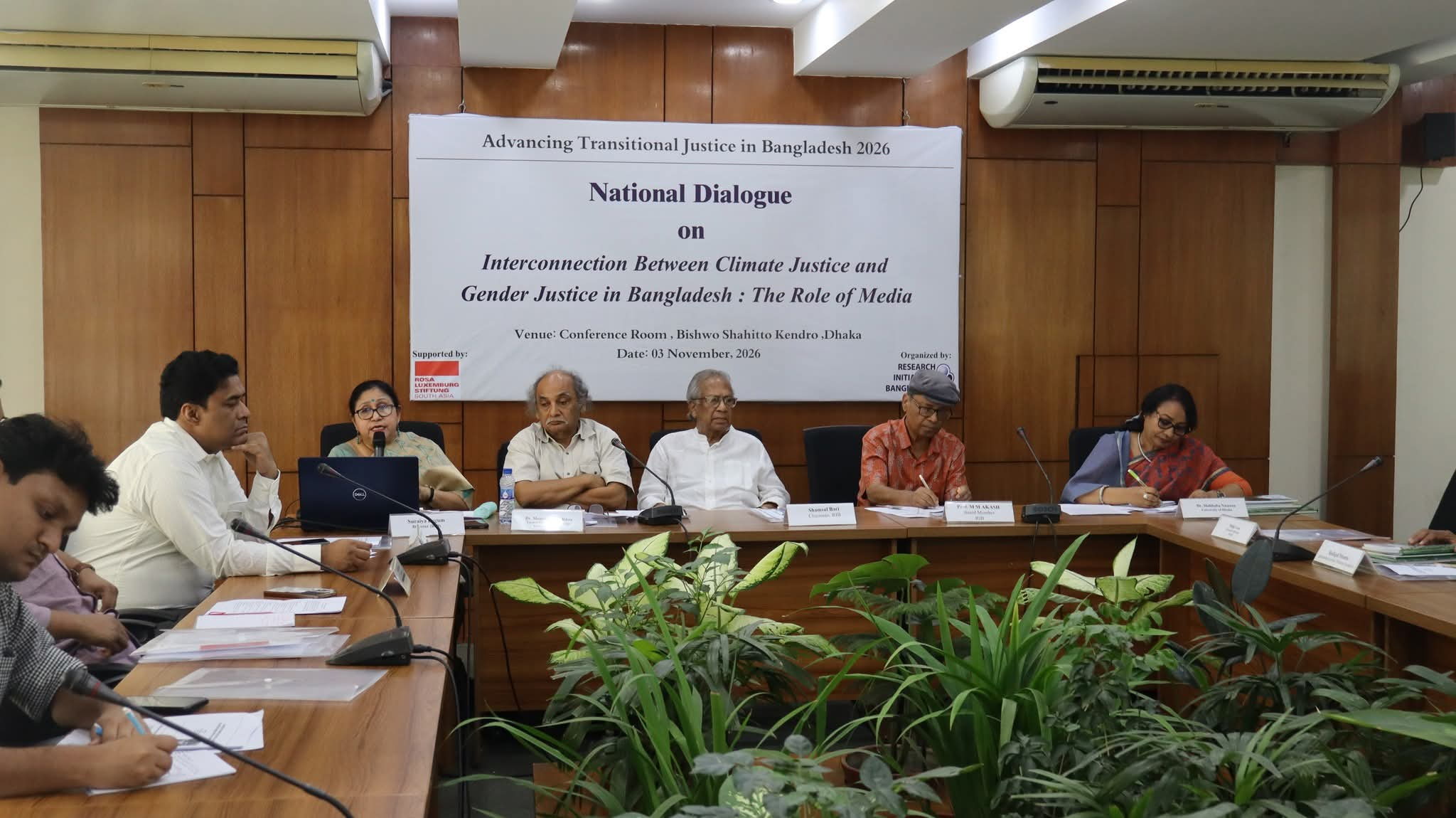
Research Initiatives Bangladesh (RIB) organised a national dialogue titled “Interconnection Between Climate Justice and Gender Justice in Bangladesh: The Role of Media” on 3 November 2026 at Bishwo Shahitto Kendro, Dhaka. The event was organised under RIB’s project, Advancing Transitional Justice in Bangladesh 2026, with support from Rosa Luxemburg Stiftung (RLS), South Asia.
The dialogue brought together journalists, editors, researchers, academics and civil society representatives to explore the relationship between climate change, gender inequality and social justice in Bangladesh. Participants discussed how responsible and inclusive media coverage can contribute to greater public awareness, strengthen accountability and bring the experiences of climate-affected communities into national discussions.
The event emphasised the importance of moving beyond conventional disaster-focused reporting towards more comprehensive, gender-sensitive and evidence-based climate journalism.
Event Information
Organised by: Research Initiatives Bangladesh (RIB)
Supported by: Rosa Luxemburg Stiftung (RLS), South Asia
Project: Advancing Transitional Justice in Bangladesh 2026
Event: National Dialogue on “Interconnection Between Climate Justice and Gender Justice in Bangladesh: The Role of Media”
Date: 3 November 2026
Venue: Bishwo Shahitto Kendro, Dhaka, Bangladesh
Connecting Climate Justice with Gender Justice
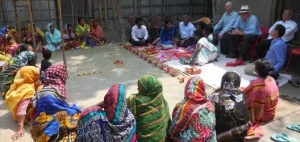
Climate change does not affect every community equally. Its consequences are often more severe for people who already experience social, economic and institutional inequalities. Women, Indigenous peoples and other marginalised communities frequently face additional challenges in accessing resources, participating in decision-making and protecting their livelihoods during climate-related crises.
The dialogue highlighted the importance of understanding climate change not only as an environmental issue but also as a matter of justice, equality and human rights.
Participants discussed how gender inequality can intensify the effects of environmental challenges and why climate-related policies and programmes must consider the different experiences and needs of affected communities.
The discussion also emphasised that women and marginalised groups should not be portrayed merely as victims of climate change. Their knowledge, leadership, resilience and contributions to local adaptation and community-based solutions deserve greater recognition in media coverage.
The Role of Media in Promoting Climate Accountability
A major focus of the dialogue was the responsibility of media organisations in shaping public understanding of climate change and its social consequences.
Participants observed that climate reporting often concentrates on natural disasters, immediate damage, rescue operations and relief activities. While these subjects are important, such coverage may overlook the deeper structural issues behind climate vulnerability.
The discussion called for journalism that investigates the underlying causes of vulnerability, examines institutional responsibilities and connects local experiences with national policies and development priorities.
The participants also stressed the importance of using reliable research, verified information and community-level evidence when reporting on climate-related issues. Stronger collaboration between journalists, researchers and climate-affected communities was identified as an important way to improve the quality and depth of public discourse.
Key Priorities Emerging from the Dialogue
The national dialogue identified several important priorities for strengthening climate and gender justice reporting in Bangladesh.
Strengthening gender-sensitive and inclusive journalism: Media coverage should reflect the different experiences of women, men and marginalised groups affected by climate change. Gender perspectives should be integrated into climate reporting rather than treated as a separate or occasional topic.
Bringing community experiences into national discussions: Journalists should give greater visibility to the voices, knowledge and lived experiences of climate-affected communities, particularly those whose perspectives are often underrepresented in mainstream media.
Promoting research-based reporting: Reliable data, academic research, field-level evidence and expert analysis should play a stronger role in climate journalism and policy discussions.
Encouraging collaboration and accountability: Stronger relationships among journalists, researchers, civil society organisations and affected communities can help produce more comprehensive reporting and encourage greater institutional accountability.
These priorities reflect the need for a media environment that informs the public while also encouraging meaningful engagement with climate justice and gender equality.
Distinguished Participation from Academia, Media and Civil Society
The dialogue was chaired by Dr. Shamsul Bari, Chairman of Research Initiatives Bangladesh (RIB). The session was moderated by Dr. Monirul Islam Khan, former Professor at the University of Dhaka, while Suraiya Begum, Director and Project Coordinator of RIB, delivered the keynote presentation.
The event featured contributions from distinguished academics, researchers and media professionals, including:
- Dr. Mahbuba Nasreen, Professor, University of Dhaka.
- Dr. Md. Khorshed Alam, Associate Professor, Department of Mass Communication and Journalism, University of Dhaka.
- Rofiqul Montu, independent award-winning journalist.
- Iftekhar Mahmud, Editor, Dhaka Stream.
- Pinaki Roy, Chief Reporter, The Daily Star.
- Habibur Rahman, Senior Broadcast Journalist, Channel One.
- Ahmed Reza, Senior Broadcast Journalist, Jamuna TV.
- Md. Ibrahim Khalilullah, Executive Editor, The Climate Watch.
- Jesmin Papri, Journalist, Rokeya Collective.
Journalists representing several national newspapers and television channels, including Bangla Vision, Channel 24, Somoy TV, New Age and The Financial Express, also attended the dialogue.
Faculty members from State University of Bangladesh, University of Liberal Arts Bangladesh (ULAB) and Daffodil International University (DIU) were among the participants, contributing academic and professional perspectives to the discussions.
Professor M. M. Akash, Board Member of RIB, delivered the closing remarks, bringing the dialogue to a close.
Advancing Inclusive and Evidence-Based Climate Discourse
The dialogue reinforced the importance of connecting local realities with broader national climate policies, adaptation programmes and climate finance discussions.
It highlighted how media can serve as an important bridge between climate-affected communities, policymakers, researchers and development institutions. By reporting on the unequal impacts of climate change and giving visibility to underrepresented voices, journalism can contribute to a more informed and accountable approach to climate action.
The discussions also underlined that meaningful climate justice requires more than environmental interventions. It demands attention to social inequality, gender-based barriers, community participation and the rights of people most affected by environmental change.
Through initiatives such as this national dialogue, Research Initiatives Bangladesh continues to facilitate discussions that bring together diverse perspectives and encourage greater public engagement with important social justice and development issues.
The event concluded with a shared emphasis on promoting inclusive, gender-sensitive and evidence-based climate reporting in Bangladesh, ensuring that the voices and experiences of vulnerable communities receive the attention they deserve.